LinkedIn Intelligence: Mapping LinkedIn’s New Engagement Hierarchy Part 2
Mapping LinkedIn’s New Engagement Hierarchy | Part 2
Last week, we broke down the four stages of LinkedIn’s content distribution pipeline and introduced the platform’s hidden three-tier engagement hierarchy.
Now, the critical question is: how do you actually engineer your content and activity to trigger Tier 1 amplification?
It comes down to understanding two specific metrics that dominate the 2026 feed: Comment Velocity and Dwell Time (the exact duration a professional spends actively reading or interacting with an update).
But before we jump into it, a quick refresher on the three-tier engagement hierarchy:
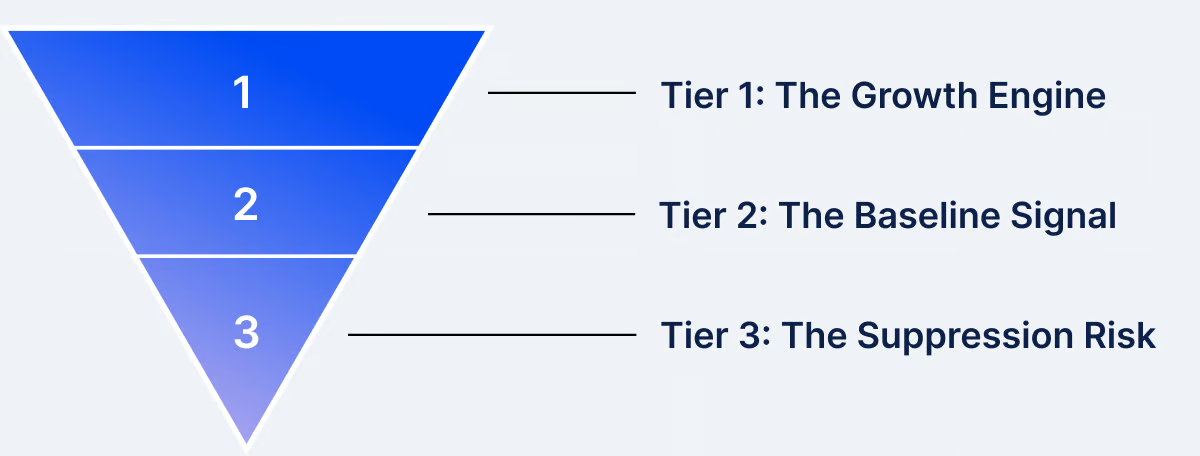
Substantive comments, deep multi-sentence comment threads, and shares accompanied by unique user commentary.
Tier 2: The Baseline Signal
Profile visits, standard reactions (likes, loves, celebrates), and private content saves.
Tier 3: The Suppression Risk
Raw impressions and outbound link clicks. Raw views offer zero distribution momentum, while outbound links actively work against platform session time.
LinkedIn rewards actions that build active community spaces directly inside the feed. Recent research reveals that substantive comments carry 15 times more algorithmic weight than a basic like, making them the primary ranking signal on the platform.
Independent testing across tens of thousands of corporate posts highlights the exact compliance benchmarks required to activate this multiplier:
The 15-Word Rule:
Short, generic reactions like “Great post!” or “Thanks for sharing” are heavily discounted by automated spam filters. Meanwhile, comments exceeding 15 words are indexed as genuine thought leadership and carry double the algorithmic impact.
The Two-Hour Window:
Your availability immediately after publishing is critical. Replying to incoming comments within the first 2 hours triggers an aggressive reach expansion, generating a 30% lift in total engagement across the post’s lifecycle.
The Link Suppression Challenge:
Placing an external URL directly in the post body results in an immediate 40-50% reduction in organic reach. The platform’s retrieval layer penalises posts that act as exit points, diverting traffic away from LinkedIn, while leading the audience off the platform directly reduces their likelihood of engaging meaningfully with the post.
To consistently capture deep dwell time, format selection must match audience behaviour. Posts that hold a user’s attention for more than 60 seconds achieve an average 15.6% engagement rate, compared to just 1.2% for updates that get scrolled past in under 3 seconds.
PDF Carousels:
Document posts pull an average 6.6% engagement rate. Because the algorithm tracks slide completion, clean, mobile-friendly 6-9-page slide decks radically inflate on-post dwell time.
Pure Text:
For raw organic visibility, text-only posts (150–300 words) yield the highest top-of-funnel reach. Because they mimic natural, peer-to-peer communication, the semantic filter routes them aggressively to feeds.
The Single-Image Balance:
High-quality text paired with a personalised selfie, unique workplace photo, or proprietary data chart secures an 11% distribution lift. Conversely, matching copy with a generic stock photo triggers a low-utility signal, causing the post to underperform pure text by up to 30%.
Native Video:
Short-form native video (30–90 seconds) remains incredibly stable for building personal connections, provided hardcoded captions are embedded, as 91% of professionals view content on mute.
At FDC, we translate these raw attention metrics into high-performing active execution for our clients:
The 60-Minute Engagement Process:
Because a post’s lifecycle is decided in the first hour, we actively manage your presence during this critical testing window. We engineer multi-sentence responses and ask clarifying questions to intentionally build deep, multi-thread conversations, triggering the Tier 1 velocity signals that expand reach to out-of-network cohorts.
Engineering Content for Dwell Time:
Every piece of media we craft is structured to satisfy the platform’s attention metrics. We build mobile-optimised, high-contrast PDF carousels to drive high slide-by-slide completion rates, and we pair text updates exclusively with proprietary data charts or authentic, personalised photography. We completely eliminate the stock imagery that triggers automated low-utility penalties.
If your corporate positioning strategy needs to be re-aligned with the 2026 LinkedIn updates, reach out to your Account Manager or connect with our positioning experts at [email protected].
Sources: Richard van der Blom (Global Algorithm Insights Report), Dr. Paul Irolla / Meet Lea (2026 LinkedIn Algorithm Technical Deep Dive), DSMN8 (Employee Advocacy & Format Benchmarks 2026), Teract AI (Dwell Time Analysis).