LinkedIn Intelligence: LinkedIn is Quietly Tracking Your AI Content
LinkedIn is Quietly Tracking Your AI Content
Many people haven’t noticed the subtle shift happening on LinkedIn yet.
AI-generated content is starting to be labelled publicly. Not everywhere. Not fully. But it’s already happening.
What’s already in place
On LinkedIn, AI-generated images can now be identified and labelled in-stream. You may have seen a small icon appear on certain images. LinkedIn calls this Content Credentials.
When clicked, it shows:
- Whether the image was generated using AI
- Which tool was used
- A verified trail of how the content was created
This forms part of a broader industry push (via C2PA) to improve transparency around AI-generated media.
Importantly, this tagging is:
- Automated
- Always on
- Not something users can opt out of
For now, this applies to images only. But it’s a clear signal of where things are heading.
What about written content?
For written posts, there’s no automatic labelling – yet. Disclosure is still largely voluntary. But expectations are shifting quickly.
Recent data shows:
- 91% of consumers expect AI-generated content to be disclosed
- Only around 30% currently trust AI-generated content
- 32% trust brands less when content feels AI-generated
Even without labels, audiences are already responding to it.
Why does it matter?
LinkedIn isn’t just another content platform. It’s built on credibility.
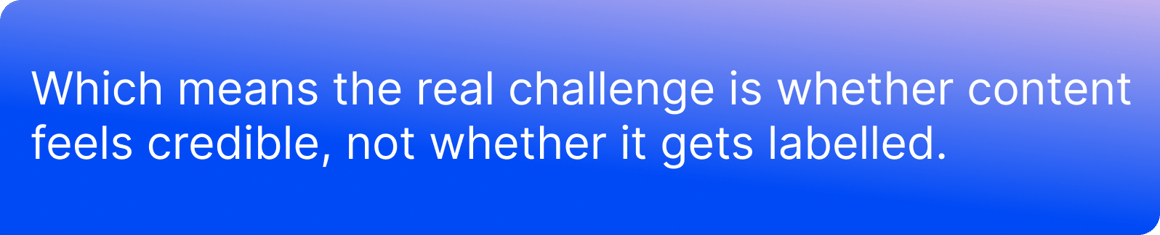
As more AI-generated content enters the feed, the distinction isn’t just technical – it’s perceptual. Content that feels generic, over-produced or disconnected from real experience weakens positioning.
The shift we’re watching
AI-generated images are already being flagged. Written content isn’t. But the direction is clear. Platforms are moving toward greater transparency, and it’s likely that more formal disclosure mechanisms will follow. In the meantime, audiences are acting as the filter. They’re already deciding what feels real, and what doesn’t.
Our Approach
At FDC, AI is part of how we work, but it doesn’t replace the thinking.
We use it to support structure, research and efficiency. But every piece of content is grounded in real expertise, clear positioning and human insight. Because, as more content is generated, what stands out is what feels real As this evolves, ask yourself, does your content sound like you – or like everyone else? That distinction is more important than ever before.
The LinkedIn content environment continues to change, and if you’d like guidance on how to navigate it, speak to your Account Manager or reach out to our team at [email protected].