LinkedIn Intelligence: Gamifying the Platform’s InMail Loop
Back in 2021, LinkedIn was a bit of a wild west. You could shoot out hundreds of connection requests a week, automation tools ran rampant, and everyone’s inbox was an avalanche of pitch-slaps. But because nobody likes getting spammed into oblivion, the platform aggressively changed course.
Fast forward to today, and LinkedIn has officially put your outbound operation on a strict diet, and has generally become a much more tolerable place.
The days of treating the platform like a free mass email channel are officially over. Across the board, whether you are on a Basic, Premium, or Sales Navigator tier, your standard connection requests are clamped down to a baseline of roughly 100 invitations per rolling 7-day window.
If your team tries to play the old volume game, you will burn through your entire messaging budget in a heartbeat, trigger the platform’s alarm bells, and land your profile in a temporary account lock.
The Anatomy of a High-Stakes InMail
Fortunately, every story has a hero. When connection caps tighten, InMails become the absolute MVP of your outbound strategy. Think of an InMail as a VIP back-stage pass – it lets your team bypass connection request walls entirely and drop directly into the inboxes of 2nd- and 3rd-degree decision-makers.
However, LinkedIn makes sure you respect the privilege with some strict boundary lines:
- The Single-Shot Rule: You cannot send a follow-up InMail to a prospect until they actually accept and reply to your first one. You get exactly one shot to make a stellar impression, so you’d better make it count.
- The Character Diet: Your subject line is capped at a crisp 200 characters, and the message body gives you up to 1,900 characters to work with.
- The Rollover Cap: Unused credits will roll over month-over-month, but the platform caps your piggy bank at exactly three times your monthly allowance. For a Sales Navigator Core seat, that means you can accumulate a maximum of 150 credits before any extra additions are permanently forfeited.
Because standard premium plans only give you a modest baseline of 50 credits a month, these messages can feel like finite, expensive digital capital, and they very much are.

Gamifying the 90-Day Loop
LinkedIn’s internal architecture is engineered to penalise generic copy-paste spam, but it loves high-relevance networking.
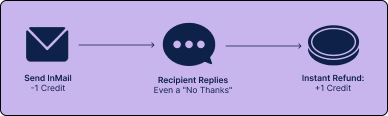
When you fire off an InMail, one credit is deducted from your balance. But here is the magic trick: if the recipient accepts or replies to that message within 90 days, LinkedIn instantly drops that credit right back into your account.
Suddenly, your messaging budget isn’t a fixed brick wall anymore. A sales team blasting out low-effort pitches will go bankrupt in a flash. But a targeted team operating with precision can recycle their credit capital over and over again.
Look at the maths: if you send 100 InMails and earn a 50% response rate, you get 50 credits back. Deploying those 50 recycled credits yields another 25 refunds, which turns into 12, then 6, effectively turning a tiny, finite allowance into a highly sustainable pipeline engine.
The Playbook: How to Earn the Refund
To keep the credits flowing and your profile out of the platform’s penalty box, your outbound framework needs to follow a few core, first-party rules:
- Keep it Short: Less is infinitely more. First-party data from LinkedIn reveals that InMails under 400 characters experience a 22% higher response rate than the platform average. Meanwhile, massive, wall-of-text messages over 800 characters consistently underperform. Brevity drives the refund loop.
- Pace Your Invitations: The platform tracks behaviour on a strict 168-hour rolling clock. Blasting your weekly limit all in a single Tuesday morning is a fast track to getting flagged as a bot. Keep it natural with an informal daily pacing limit of 20 to 25 invitations spread evenly throughout the week.
- Fish Where the Bites Are: Target cohorts who are structurally primed to talk to you. Prospects who already follow your corporate company page are 81% more likely to respond to an InMail. Plus, referencing a common former employer or a mutual connection can make your reply rate jump by 27%.
The Multi-Touch Boost: Sending just one lonely follow-up message can actually drop your engagement by 0.6% compared to sending no follow-up at all. But structuring a deliberate sequence that includes a second follow-up delivers a 4.05% lift in overall response rates
The FDC Approach: Precision Over Volume
The true utility of your LinkedIn account grows exponentially when you stop trying to scream at more people and focus entirely on identifying the correct people.
At FDC, we don’t believe in the numbers game; we never have. We believe in the data game. The platform’s ranking algorithms are always watching network feedback: keeping your connection acceptance rate above 30% to 40% tells the trust filters that your outreach is genuinely welcome, dynamically protecting your profile from strict weekly throttling.
We then step in as the expert filter, pinpointing the active, high-intent target segments within your exact ICP. By matching real human relevance with LinkedIn’s structural constraints, we ensure tangible outbound engagement, keep your core profile healthy, and turn platform scarcity into an elite competitive advantage.
Winning the modern B2B outbound game requires a strategic partner who knows the rules inside and out. If you’re ready to optimise LinkedIn’s architecture and start leveraging the powerful resources available, reach out to your Account Manager or connect with our team at [email protected].
Sources:
- LinkedIn InMail Best Practices Guide: 10 Ways to Grab Attention (McLaren & Dewar)
- Belkins Contact-Level Outreach Study & Expandi Platform Benchmarks (15.1M Contact Data Evaluation Update)
- LinkedIn Premium Subscriptions & Billing Policy Manual (InMail Credit Lifecycle, Lifecycle Rules & Rollover Accrual Metrics)