LinkedIn Intelligence: Mapping LinkedIn’s New Engagement Hierarchy Part 1
Mapping LinkedIn’s New Engagement Hierarchy | Part 1
If you are treating every like, share, and comment on LinkedIn as equal, your distribution strategy is stalling.
With platform-wide organic impressions compressed by over 60% according to international benchmarking studies, the algorithm has fundamentally shifted away from measuring passive engagement volume.
Instead, the feed relies on a strict, hidden valuation system to score your content.
To help our network adapt, we have mapped out the 2026 Engagement Hierarchy. This breakdown details exactly how the platform’s multi-stage distribution pipeline values every single interaction your content receives.
The Content Evaluation Pipeline
The progression of an organic post from submission to platform-wide visibility is governed by a sequential, four-stage distribution pipeline.
Let’s unpack it:
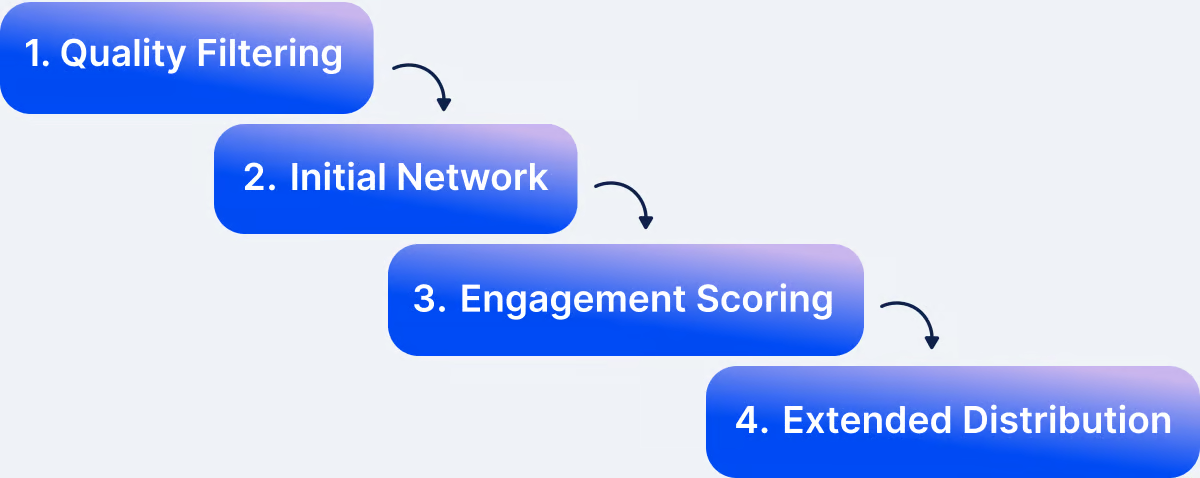
Stage 1: Quality Filtering – Immediate
An automated AI filter scans your text structure, and link placement to sort it into a quality category.
Stage 2: Initial Network Test – First 30–60 Mins
The algorithm displays your update to a tiny test sample (roughly 2% to 5%) of your most active connections to measure early engagement velocity.
Stage 3: Engagement Scoring – 2–6 Hours
The system processes initial metrics to calculate a “Depth Score.” If a post underperforms here, it rarely recovers – only 5% of lagging posts survive past this phase.
Stage 4: Extended Distribution – Days to Weeks
High-scoring posts are pushed out to 2nd-degree networks, out-of-network topic groups, and local feed indices as “suggested content.”
Decoding the Three-Tier System
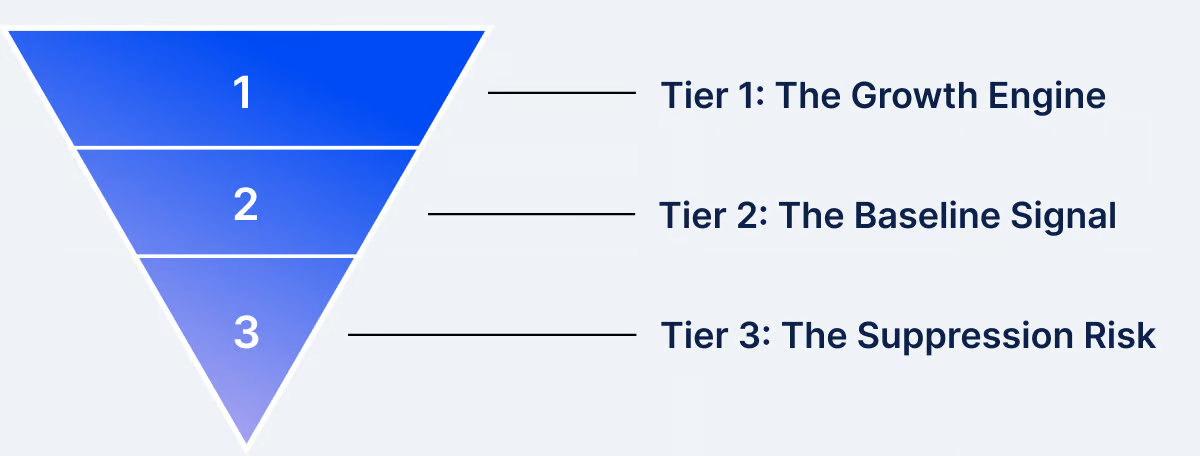
During the Stage 2 and Stage 3 evaluation windows, the algorithm applies a weighted point system to every single action your post receives. Passive clicks are heavily discounted, while high-effort interactions instantly satisfy the system’s core indexing requirements, signalling that your content deserves macro-distribution.
The mathematical hierarchy breaks down into three distinct behavioural tiers:
Stage 1: Quality Filtering – Immediate
An automated AI filter scans your text structure, and link placement to sort it into a quality category.
Stage 2: Initial Network Test – First 30–60 Mins
The algorithm displays your update to a tiny test sample (roughly 2% to 5%) of your most active connections to measure early engagement velocity.
Stage 3: Engagement Scoring – 2–6 Hours
The system processes initial metrics to calculate a “Depth Score.” If a post underperforms here, it rarely recovers – only 5% of lagging posts survive past this phase.
Stage 4: Extended Distribution – Days to Weeks
High-scoring posts are pushed out to 2nd-degree networks, out-of-network topic groups, and local feed indices as “suggested content.”
Our Approach: Active Pipeline Optimisation
At FDC, we don’t just post content and walk away. We actively manage the operational levers required to push your updates cleanly through Stage 1 and Stage 2 of the distribution pipeline:
Algorithmic Pre-Vetting:
Before any piece of content goes live, our editorial team audits the copy against LinkedIn’s automated quality filters. Ensure text structure favours executive skimming, and prevent the low-quality classification flags that freeze reach at Stage 1.
Semantic Profile Alignment:
We structurally re-align our clients’ profile metadata, specifically headlines, about sections, and listed skills, to match their content pillars. By eliminating classification mismatches, the dense retrieval model can seamlessly index and route updates straight to the correct target audience cohort during the initial network test.
If your executive positioning strategy needs to be aligned with the modern interest graph, reach out to your Account Manager or connect with our positioning experts at [email protected].
Sources: Richard van der Blom (Global Algorithm Insights Report), Dr. Paul Irolla / Meet Lea (2026 LinkedIn Algorithm Technical Deep Dive), Socialinsider (Platform Engagement Metrics).